The Cheapest Screw Press Offer Is Usually the Narrowest One
The Cheapest Offer Is Usually the Narrowest One: A Scope-and-Evidence Method for Comparing Screw Press Dewatering Quotes
TNW Co., Ltd — Engineering Note Series · November 2026
A dewatering tender rarely fails because the machine was wrong. It fails because two quotations were read as if they described the same delivery, and they did not. One number covered a press on a skid; the other covered a working installation with feed pumping, polymer preparation, a control cabinet, cake handling, commissioning and a year of wear parts. Comparing those two totals is not a price comparison. It is a comparison of two different projects that happen to share a model name.
What follows is the method we recommend to buyers evaluating multi-disk screw press offers — ours included. It is deliberately unglamorous: it is about documents, definitions and testable clauses, not about which brand has the better brochure.
Read the price last
A quotation is not a price tag. It is a draft of the contract, written before anyone has agreed what the contract means. Everything that will later be argued about — who supplies the polymer unit, who sizes the feed pump, who pays for the lifting gear, who is responsible when the cake runs wet — is decided at the moment the offer is written, usually without either party noticing.
So the order of reading matters. Open the offer at the scope annex first, then the performance statement, then the commercial terms, and only then the total. If the scope annex does not exist, that is the finding, not the price.
Three envelopes sit inside every offer
Every screw press offer carries three separate envelopes, and they can be opened in any order but must all be opened.
The equipment envelope — what physically arrives. The press, its drive and washing arrangement, and then a variable set of auxiliaries: feed pump, flocculant preparation and dosing skid, instrument air, wash-water booster, control cabinet, cake conveyor, local piping, support steel, walkways.
The performance envelope — what the equipment promises to achieve, and on what feed. A dryness figure without a sludge basis is not a promise; it is a number with no owner.
The liability envelope — who carries which risk after the invoice is paid. Warranty start event, wear-part coverage, response obligations, spare-part lead times, delay remedies, and the size of the retention that survives acceptance.
Offers that look 20% apart usually differ mainly in the third envelope. The price gap is the visible part of a risk transfer that nobody wrote down.
The normalisation kit: one card, three tables
Rather than comparing quotations as they arrive, convert each of them onto a single internal template before you look at money. Four artefacts are enough.
1. The sludge basis card
Fill this in before the RFQ goes out, and attach it to every offer so that no supplier can size to a different assumption.
| Field | What to record |
|---|---|
| Sludge origin | Municipal mixed, surplus activated, DAF float, food-processing, slaughterhouse, chemical, paper, dredging |
| Inlet solids | Typical and seasonal range, expressed as % DS or mg/L, with the sampling point named. Multi-disk presses are normally applied between 2,000 mg/L and 50,000 mg/L |
| Fibrous / gritty content | Screenings, hair, shell, sand — the items that decide whether a self-cleaning ring stack survives |
| Oil and grease | Presence and rough concentration; the single most common cause of a failed first commissioning |
| Flow pattern | Average, peak, and hours per day; batch or continuous |
| Polymer regime | Type in current use, dose per tonne DS, preparation water quality |
| Target cake | % DS target, plus disposal route, because landfill, incineration and composting tolerate different cake |
| Site constraints | Footprint, headroom, floor loading, wash-water availability, drainage of filtrate |
Any offer that cannot be restated against this card stays outside the comparison. Not ranked lower — outside it.
2. The scope table
Nine lines, three columns. Each supplier marks I (included), E (excluded), O (optional, priced separately). The marks below show how we draw the line on a standard TNW package, so that a buyer has a reference point to compare against; every project still gets its own annex.
| Line item | I / E / O | Remarks |
|---|---|---|
| Screw press, drive, washing arrangement | I | Multi-disk unit with fixed and moving ring stack, wash nozzles, backpressure plate |
| Sludge feed pump and its sizing basis | I | Sized on the sludge basis card, not on a catalogue maximum |
| Flocculant preparation and dosing skid | I | Three-chamber dissolution and curing unit with automatic linkage to the press |
| PLC cabinet, alarm list, remote access | I | Variable-frequency drive, torque-limited operation, alarm and remote-support route |
| Cake conveyor or skip interface | O | Depends on the disposal route and the room available under the discharge |
| Wetted material grade, with mill certificates | I | SS304 as standard; SS316 or carbide-coated screw as project options |
| Piping, valves, support steel, walkways | O | Usually by the installing contractor; we will supply the interface drawings |
| Installation, commissioning, operator training | O | Offered as a service line; strongly recommended on first-of-type sludge |
| Spare ring set, shaft, recommended stock | O | Recommended: one ring set plus one shaft on site from day one |
The table is not administrative. It is the instrument that makes a cheaper offer visibly cheaper for a reason.
3. The performance table
Throughput, cake dry solids, solids capture and polymer consumption — each stated against the sludge basis card, with model, test duration and measurement method. One nominal capacity figure from a catalogue does not enter this table.
Cake moisture is the figure most often quoted loosely, so pin it down first. Across our range the working band is 60%–85% moisture, i.e. 15%–40% dry solids, with the exact operating point set by sludge family, conditioning and ring-gap configuration. Where we hold measured field data — four sludge families, sampled on stable running installations rather than bench trials — the band sits tighter:
| Sludge family | Inlet moisture | Cake moisture actually measured | Frames typically used |
|---|---|---|---|
| Municipal activated sludge | 98%–99.5% | 75%–80% | TNW-201, TNW-301, TNW-402 |
| Slaughterhouse, food and livestock manure | 97%–98% | 76%–82% | TNW-301, TNW-402 |
| Viscous oily sludge (printing, chemical, pharmaceutical) | ~97%–99% | 78%–83% | Custom ring-gap units on TNW-352 / TNW-402 frames |
| River dredging and slightly sandy slurry | 96%–99% | 78%–83% | Carbide-coated screws on TNW-402 / TNW-403 frames |
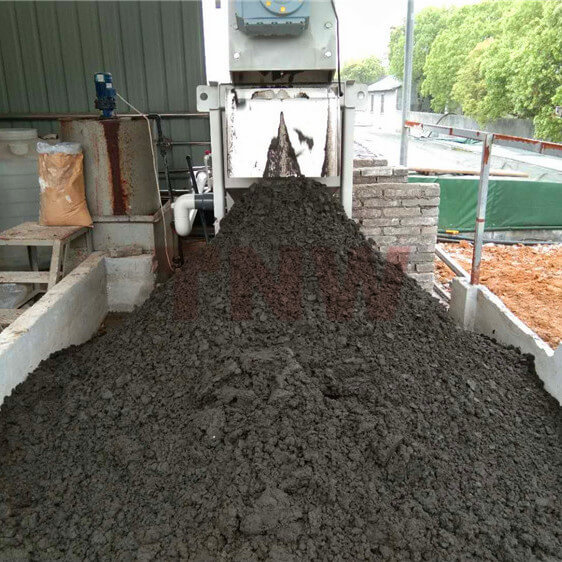
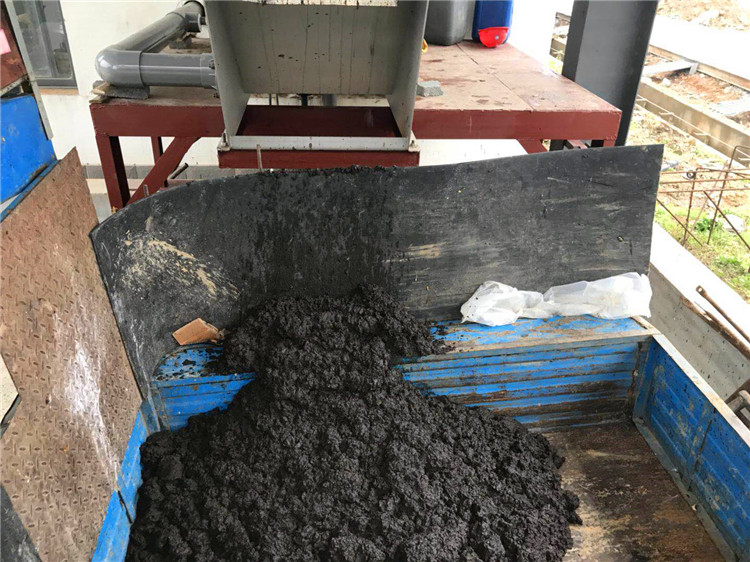
Two things follow from that table. First, a single "our cake is 60% moisture" claim across all sludge types is not a specification; it is a hope, and the honest version of the promise is a band plus the sludge it applies to. Second, the number that matters for disposal cost is the one you can reproduce in month six, not the one achieved on the first afternoon with fresh polymer. Units that drift past 85% moisture within weeks — cloudy filtrate, wet cake, repeated cleaning — are the failure mode that this whole comparison is designed to catch before signature.
Source for the measured figures: TNW field datasets published on our performance page; inlet and outlet figures are site-sampled, not laboratory-ideal.
A worked example of how the table gets filled, for a municipal case:
Inlet: 2% DS (98% moisture), surplus activated sludge, 24 h/day
Offered frame: TNW-402, rated 17.0 m³/h on the model datasheet
Committed cake: 75%–80% moisture (20%–25% DS), with the sampling point at the discharge chute and the laboratory named in the order
Committed solids capture and polymer dose per tonne DS: measured during the acceptance run, not estimated from a competitor's brochure
Result to expect: sludge volume cut by more than 70%, cake firm enough for landfill or composting without dripping
4. The risk ledger
One column per offer: currency and Incoterm with named place; price validity; payment milestones; lead-time trigger (order, deposit, drawing approval, import permit); warranty length and the event that starts it; whether wear parts are inside warranty; spare-part lead time; response commitment with a defined clock and a defined area; delay remedy; retention held past acceptance.
The warranty start event deserves its own line because it is the most quietly expensive term in the ledger. A warranty that begins at shipment can be half gone before the plant has run a full sludge cycle; one that begins at acceptance keeps the risk where the supplier can still act on it.
Capacity numbers are claims, not measurements
Publishing a feed capacity in cubic metres per hour, or in kilograms of dry solids per hour, is normal — and comparing two such numbers is meaningless unless both were produced the same way. Sludge type, inlet concentration, flocculant dose, target dryness, model, run length and sampling method all shift the result, often by a factor rather than a percentage.
We therefore grade evidence instead of ranking figures:
Tier A — measured on your sludge. A bench or pilot run, or a site trial, with a written report naming feed solids, cake solids, polymer type and dose, model, duration and sampling method.
Tier B — documented on a comparable reference. A named installation, same sludge family and similar capacity band, with permission to speak to the operator.
Tier C — stated in a catalogue or a quotation. Useful for budgeting and for pre-qualification, not for acceptance.
A quotation built only on Tier C numbers has told you what the supplier believes, not what the supplier will be held to. That is fine for a budget, and not fine for a purchase order.
Our own datasheets state model-level capacities — the TNW-402, for example, is rated at 17.0 m³/h — and those figures still need restating on a buyer's sludge before they mean anything at that site.
The acceptance script: three acts, run on site
Acceptance is not a clause; it is a sequence of tests with named witnesses. Split it into three acts and refuse to merge them into one sentence about "satisfactory operation".
Act one — mechanical and electrical completion. Seal and joint leak checks including wash-water lines; drive alignment and rotation; guarding; measured noise at agreed points; wetted material grade verified against the mill certificates supplied with the steel; corrosion protection inspected. These are the failures that show up in month one, and they are cheap to fix at commissioning and expensive to fix in service.
Act two — control behaviour. Walk the alarm list item by item; run the automatic sequence under stable conditions; confirm the remote-support route actually connects; record what the PLC does when the feed stops, when the flocculant runs out, and when the torque limit is reached. Most "unstable" installations are tuning and control-logic problems dressed as hardware faults.
Act three — performance on the agreed feed. Cake dry solids, solids capture, polymer consumption per tonne of dry solids, and throughput, measured over a defined continuous run, with the sampling point and the laboratory named in advance. Then a deliberate step for polymer optimisation and parameter adjustment, so the plant ends the commissioning tuned to the real feed rather than to a bench sample.
Two additions are worth writing in because they cost nothing to specify and a lot to discover late:
A clogging demonstration. Run the actual feed, including the screenings and fibrous material the site really produces, and show that the self-cleaning ring stack and wash cycle cope. Specifications that assume clean sludge are the most common source of a first-year complaint.
A wear baseline. Measure or inspect the screw shaft and the moving rings at handover and record it. Later, wear can be judged against a number instead of an impression.
Every criterion needs four fields: who measures, who witnesses, what happens on a miss, and when the retest closes. A criterion without a remedy is a wish.
Where the money actually leaks
Machine price is the smallest variable in the life of an installation. The larger ones, in rough order of impact:
Polymer. Dose per tonne of dry solids moves with flocculant choice, preparation quality and mixing energy. A press that needs a noticeably higher dose can cost more per year than the price difference between two presses.
Wash water and power. Low-speed screw operation is inherently frugal, but the wash cycle and the booster pump are where the consumption actually sits.
Wear parts. Rings and shaft are consumables. A recommended spare set held on site, and a stated restocking lead time, are worth more than a discount.
Downtime. A dewatering line that stops fills the downstream buffer within hours. Response time and spare availability should be compared as production terms, not service terms.
Civil and lifting scope. Retrofit projects are frequently decided by footprint, headroom and crane access rather than by the press.
Convert all five to a common basis before you decide that one offer is cheaper.
Match the emphasis to the sludge, not to the brochure
The same machine is bought for very different reasons, and the decisive clause changes with the reason.
Municipal retrofit inside an existing building. Footprint envelope, performance across seasonal sludge variation, and the service and spares commitment carry the decision. Price differences here are often piping and civil works wearing the costume of a machine discount.
Industrial or DAF sludge with oil and grease. Flocculant scope, material and corrosion option, and the wash arrangement carry the risk. Acceptance must be tied to the production sludge, not to a municipal reference — a plant that passes on municipal sludge can still fail on oily feed.
Small or decentralised sites with thin staffing. Automation scope, remote support and training become the deciding terms. A machine needing frequent manual adjustment has a higher effective cost than its purchase price suggests, at a site with nobody standing next to it.
Two statements a supplier should be willing to put in writing
References. A project count describes scale, not fit. Ask for installations in the same sludge family, the same capacity band and the same region, with permission to make contact. Our own position is that our presses are in service in more than 50 countries with over 1,000 customers, including Suez, Veolia, PetroChina, Sinopec, China Railway, Meiji Dairy, Uni-President and Shuanghui — and we still expect a buyer to ask which of those references actually resembles their sludge.
The scope statement itself. We describe our standard MDS package as press plus feed pump, flocculant dosing, control cabinet and cake conveying. Treat that as a checklist for your RFQ, not as proof that any particular quotation contains all four items. Ask for the annex, then compare the annexes.
The decision rule
Compare scopes first, performance bases second, and prices third, on the normalised template. Then buy the offer whose scope, sludge basis, acceptance test and remedy clause you can actually enforce — because that is the offer that will still be true two years after commissioning.
A screw press is one line inside a dewatering system. The terms wrapped around that line decide what the plant really receives. The most expensive mistake in this market is not overpaying for a machine; it is buying the narrowest scope at the lowest price and discovering the difference in the first wet month.
A five-line pre-tender check
Is there a sludge basis card, and is it attached to every offer?
Does every offer carry a scope table with included, excluded and optional marked?
Is every performance figure tied to the card, with model, duration and method?
Is the warranty start event written, and are wear parts inside or outside it?
Does every acceptance criterion name a measurer, a witness, and a remedy?
About TNW
TNW Co., Ltd was founded in 2013 and manufactures multi-disk screw presses for sludge thickening, dewatering and solid–liquid separation at a 10,000 m² production facility. The range runs from the compact TNW-201/202 and TNW-301 frames through the TNW-352 and TNW-401/402 twin-screw units to the TNW-403/404 multi-unit configurations, built in SS304 as standard with SS316 and carbide-coated screws available for corrosive or abrasive duty.
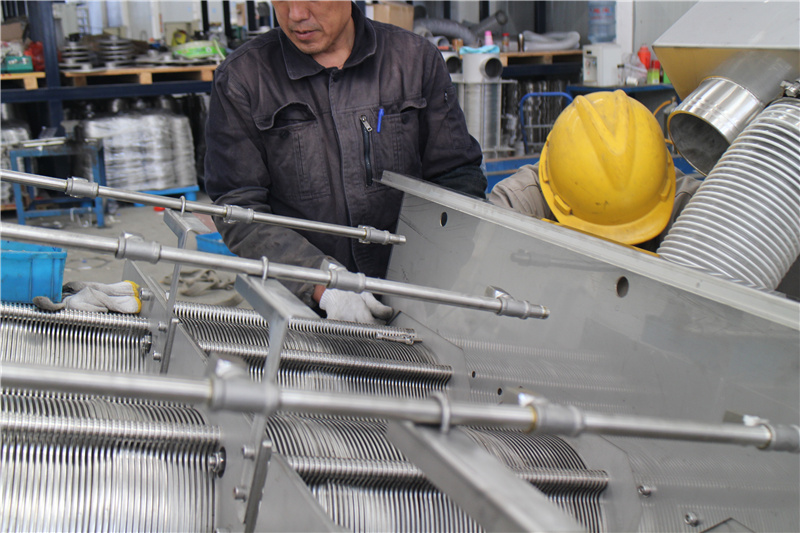
The machines combine gravity thickening and progressive screw extrusion in one inclined body: fixed rings and moving rings replace filter cloth, scrape the gaps clean at low rotational speed, and keep the ring stack from blinding on oily or fibrous sludge. Ring gaps are set per project — narrow for fine municipal solids, wider for high-fibre industrial sludge — and the backpressure plate clearance is adjustable on site to trim cake dryness without changing hardware. Siemens PLC variable-frequency control links the press to a three-chamber flocculant preparation unit, so dosing follows the feed instead of a fixed timer.
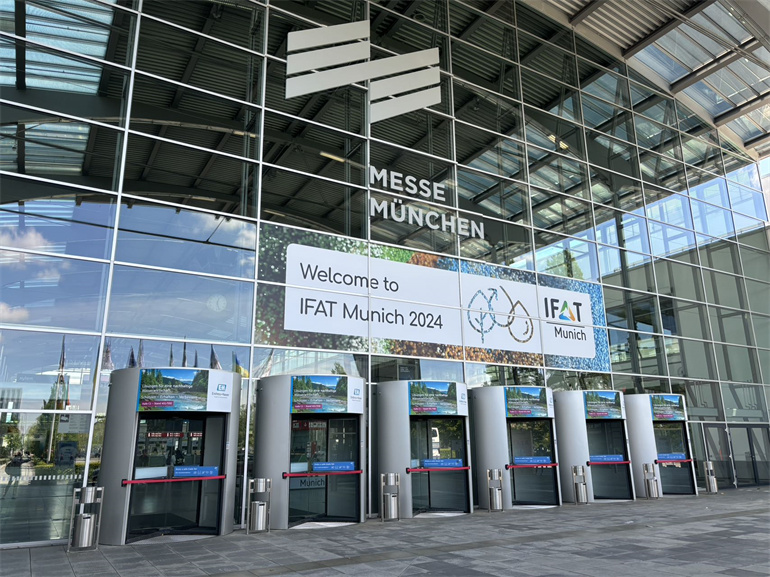
We supply feed pumping, flocculant dosing, the control cabinet and cake conveying as a matched package, pre-tested before dispatch, together with installation, commissioning and operator training. Installations are running in more than 50 countries for over 1,000 customers, and we exhibited the range at IFAT Munich 2026.
If you send your sludge type, inlet solids range, target cake moisture and required scope boundary, we will return a quotation on the template above — so it can be compared line by line with any other offer, including the ones that look cheaper.
Further reading: screw press sludge dewatering machine range · measured cake moisture by sludge type
PRE : Reasons and solutions for blockage in the screw press dewatering